
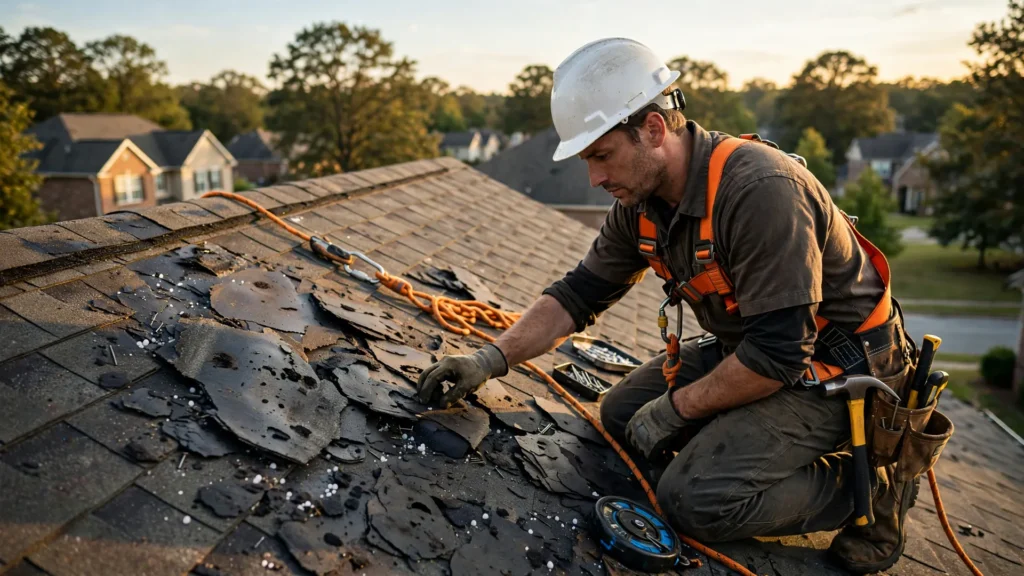
Hail does not hit Durham as often as wind does, but when it does, the damage is easy to miss. A hailstone the size of a marble can crack a shingle, knock off its protective coating, or bruise it so the damage only shows up months later as a leak. From the ground, the roof can look fine. Up close, it tells a different story.
That is why it pays to check the roof after any hailstorm, even a short one. The seven signs below are what roofers look for first. If you spot one or two of them, get the roof looked at before the next rain makes the problem worse. Most hail damage is covered by a repair, not a full replacement, when it is caught early, and our storm and wind damage repair covers hail damage across the whole city.
1. Dents and Dimples on the Shingles
The most common sign of hail is also the easiest to spot. Look for small round dents or dimples pressed into the shingles, usually in random patches where the stones hit hardest. They are often easier to feel than to see, so run your hand lightly over the shingle surface if you can reach it safely from a ladder.
Dents matter because they break the shingle’s surface. Once the surface is broken, water and sun get in, and the shingle ages much faster than the ones around it. A roof with dents all over one slope took a direct hit, and that slope needs a closer look.
2. Cracked or Split Shingles
Hard hail can crack a shingle clean through. The crack often runs in a straight line, and the shingle may feel loose or lift at the edge. In cold weather, shingles are stiffer and crack more easily, so a spring hailstorm can do more damage than the same storm in summer.
A cracked shingle cannot keep water out. Every rain pushes water through the crack and onto the layer below. One or two cracked shingles can be replaced on their own. A whole section full of them usually means the hail hit hard enough to wear out that part of the roof.
3. Granule Loss in the Gutters
After a hailstorm, check the gutters and the ground below the downspouts. If you find a lot of sand-like grit, that is granule loss. Hail knocks the granules off the shingles, and the rain washes them down into the gutters.
Granules are the shingle’s shield against the sun. Without them, the asphalt underneath is exposed, dries out, and cracks. You can also see the loss on the roof itself. Look for dark, smooth patches where the shingle looks bare compared to the rough surface around it. Heavy granule loss after one storm is a clear sign the roof took damage.
4. Bruised Shingles
Not all hail damage is visible. Sometimes a hailstone hits hard enough to bruise the shingle without breaking the surface. The spot feels soft or spongy when you press it, and the mat underneath is damaged even though the top looks normal.
Bruises are the sneakiest kind of hail damage. They do not leak right away, so homeowners think the roof survived the storm. Months later, the bruised spot cracks open and starts leaking. This is why a roof should be checked by hand after a hailstorm, not just looked at from the ground. A roofer knows how to find the soft spots before they turn into leaks.
5. Damaged Flashing, Vents, and Gutters
Hail does not only hit the shingles. It dents the soft metal around them too. Check the flashing around the chimney, the vent covers, and the gutters. Dents in these parts are often the first clue that hail fell, because metal shows the impact more clearly than shingles do.
Dented gutters can also stop draining properly, which pushes water back toward the roof edge. Bent flashing leaves gaps where water gets in every time it rains. If the metal parts of your roof look dented after a storm, the shingles almost certainly took hits as well, even if the damage is harder to see.
6. Shingles Knocked Loose or Missing
A strong hailstorm, especially one with wind behind it, can lift shingles and tear them off completely. Walk around the house after the storm and look for shingles on the ground or in the yard. Then look up at the roof for bare patches where the dark underlayer shows through.
A missing shingle leaves the roof open to the next rain. Water goes straight onto the decking, and the shingles around the gap are more likely to lift in the next wind. Loose shingles that are still on the roof but flapping at the edge are just as urgent. They will not seal themselves back down. If water is already coming inside, do not wait for a dry day — emergency roof repair is available around the clock.
7. Leaks and Stains That Show Up Weeks Later
Sometimes the first sign of hail damage appears inside the house, weeks after the storm. A brown stain on the ceiling, a damp spot in the attic, or a musty smell upstairs can all trace back to hail that cracked or bruised the shingles.
This delayed leak is common with hail. The damage opens a small path for water, and it takes time for enough water to get through to show inside. If a stain appears after a hailstorm, even a month later, have the roof checked. The longer a leak runs, the more it damages the wood and insulation above the ceiling.
Hail damage in Durham is easy to miss and expensive to ignore. If your roof has been through a hailstorm, do not wait for a leak to tell you something is wrong. Get it checked now, while the fix is still a repair. You can reach Roof Repair Durham directly at (984) 230-5620 for a free estimate before any work begins.